
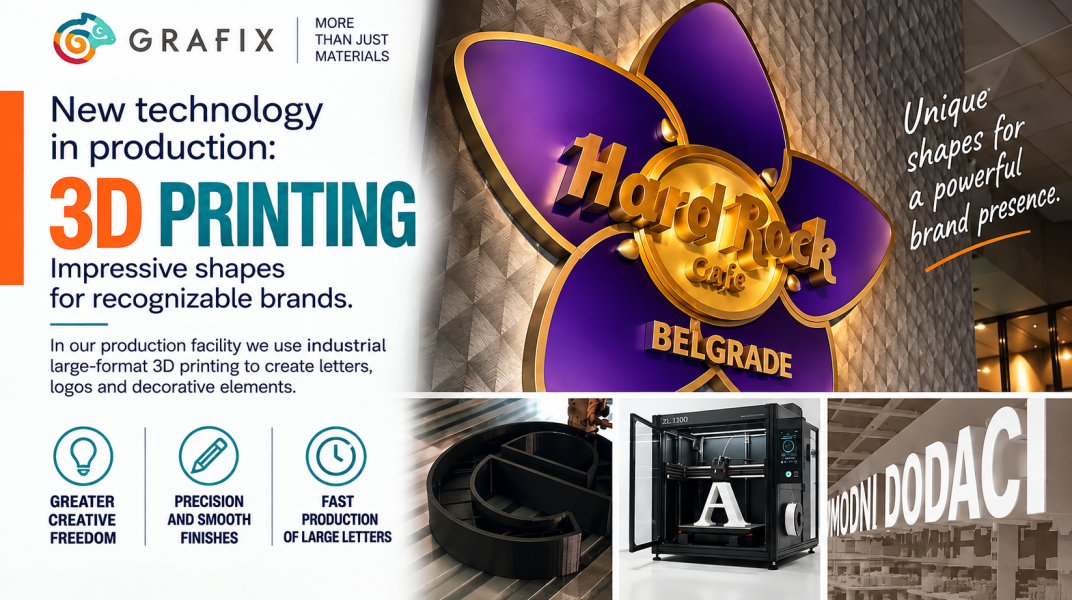
The development of industrial 3D printing has brought significant changes to the production of sign letters, logos, and other visual communication elements.
While complex shapes were previously manufactured using a combination of different technologies and manual processing, today a large part of the process can be completed with precision 3D printing, offering greater design flexibility and shorter production times.
This is particularly evident in illuminated signage, where precision, repeatability, and the quality of the final finish are essential.
Traditional technologies, such as bending aluminum profiles or machining plexiglass, still play an important role in sign manufacturing.
However, when sign letters feature complex shapes, curved lines, or require perfectly consistent production runs, 3D printing offers significant advantages.
It is most commonly used when manufacturing:
- Sign letters with complex geometries;
- Logos with intricate details;
- Custom shapes that cannot be achieved using conventional manufacturing methods;
- Small to medium production runs where every component must meet the same quality standards.
Modern industrial 3D printers deliver a high level of precision and repeatability.
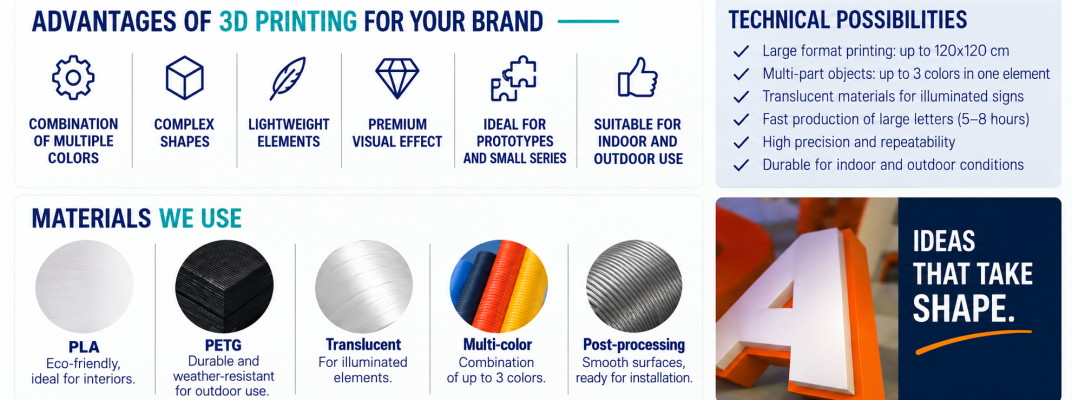
The main advantages of this technology include:
- Greater design flexibility;
- Exceptional manufacturing precision;
- Consistent quality across all components in a production run;
- Reduced weight of finished sign letters;
- Easier installation;
- The ability to integrate LED lighting during the design phase.
This technology makes it possible to achieve a level of quality that is difficult to attain using traditional methods, particularly when manufacturing highly complex shapes.
The production of sign letters using 3D printing involves several stages.
First, a three-dimensional digital model is created based on the logo or graphic design.
Next, an industrial 3D printer manufactures the components with high precision, building them layer by layer.
Once printing is complete, the process continues with finishing, LED lighting installation (when specified in the project), and final assembly of the signage element.
The digital workflow allows for easy adjustments and precise quality control throughout the entire production process.
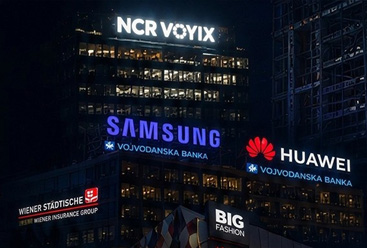
Today, this technology is used in a wide range of settings, including:
- Office buildings;
- Retail stores;
- Hotels;
- Restaurants;
- Salons;
- Offices;
- Trade show displays;
- Interior signage.
It is particularly well suited for projects where a brand’s visual identity requires custom shapes or a high-quality finish.
Industrial 3D printing is becoming an important part of modern signage manufacturing.
Rather than replacing all existing technologies, it complements them and enables the production of solutions that were previously highly complex or economically unfeasible.
As a result, it is increasingly used in projects where quality, precision, and design are just as important as the functionality of the signage itself.
In this article, we have explored the possibilities that industrial 3D printing brings to sign letter manufacturing.
If you would like to learn more about materials, technology, manufacturing options, and see examples of completed projects, visit our page dedicated to 3D-Printed Sign Letters.
Our team will help you determine when 3D printing is the best solution and when combining multiple technologies is a more efficient choice for your project.